1: The Sombrero Galaxy
The Sombrero Galaxy (also known as M104 or NGC 4594) is an unbarred spiral galaxy in the constellation Virgo. It has a bright nucleus, an unusually large central bulge, and a prominent dust lane in its inclined disk. The dark dust lane and the bulge give this galaxy the appearance of a sombrero. The galaxy has an apparent magnitude of +9.0, making it easily visible with amateur telescopes. The large bulge, the central supermassive black hole, and the dust lane all attract the attention of professional astronomers.
2: Black Eye Galaxy
A spiral galaxy in the Coma Berenices constellation, Messier 64, the famous "Black Eye" galaxy or the "Sleeping Beauty galaxy," has a spectacular dark band of absorbing dust in front of the galaxy's bright nucleus. It is well known among amateur astronomers because of its appearance in small telescopes.
3: 2MASX J00482185-2507365 occulting pair
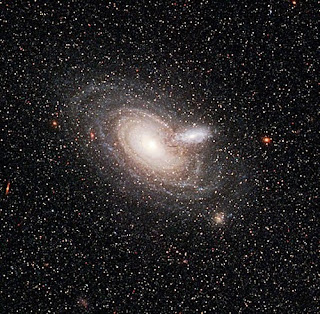
The 2MASX J00482185-2507365 occulting pair is a pair of overlapping spiral galaxies found in the vicinity of NGC 253, the Sculptor Galaxy. Both galaxies are more distant than NGC 253, with the background galaxy, 2MASX J00482185-2507365, lying at redshift z=0.06, and the foreground galaxy lying between NGC 253 and the background galaxy (0.0008 < z < 0.06). This pair of galaxies illuminates the distribution of galactic dust beyond the visible arms of a spiral galaxy. The heretofore unexpected extent of dust beyond the starry limits of the arms, shows new areas for extragalactic astronomical study. The dusty arms extend 6 times the radii of the starry arms of the galaxy, and is shown silhouetted in HST images against the central and core sections of the background galaxy.
4: The Whirlpool Galaxy
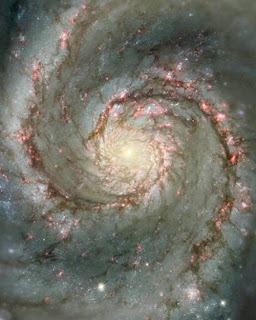
Also known as Messier 51a, M51a, or NGC 5194, the Whirlpool Galaxy is an interacting grand-design spiral galaxy located at a distance of approximately 23 million light-years in the constellation Canes Venatici. It is one of the most famous spiral galaxies in the sky. The galaxy and its companion (NGC 5195) are easily observed by amateur astronomers, and the two galaxies may even be seen with binoculars. The Whirlpool Galaxy is also a popular target for professional astronomers, who study it to further understanding of galaxy structure (particularly structure associated with the spiral arms) and galaxy interactions.
5: Grand spiral galaxy
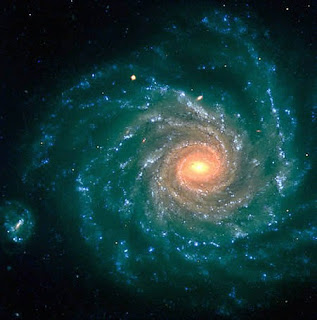
Also known as NGC 123, this fascinating galaxy is dominated by millions of bright stars and dark dust, caught up in a gravitational swirl of spiral arms rotating about the center. Open clusters containing bright blue stars can be seen sprinkled along these spiral arms, while dark lanes of dense interstellar dust can be seen sprinkled between them. Less visible, but detectable, are billions of dim normal stars and vast tracts of interstellar gas, together wielding such high mass that they dominate the dynamics of the inner galaxy. Invisible are even greater amounts of matter in a form we don't yet know - pervasive dark matter needed to explain the motions of the visible in the outer galaxy.
6: Supernova 1987A

Two decades ago, astronomers spotted one of the brightest exploding stars in more than 400 years: a doomed star, called Supernova 1987A. This image shows the entire region around the supernova. The most prominent feature in the image is a ring with dozens of bright spots. A shock wave of material unleashed by the stellar blast is slamming into regions along the ring's inner regions, heating them up, and causing them to glow. The ring, about a light-year across, was probably shed by the star about 20,000 years before it exploded. In the next few years, the entire ring will be ablaze as it absorbs the full force of the crash. The glowing ring is expected to become bright enough to illuminate the star's surroundings, providing astronomers with new information on how the star expelled material before the explosion. The image was taken in December 2006 with Hubble's Advanced Camera for Surveys. (Credit: NASA, ESA, and R. Kirshner; Harvard-Smithsonian Center for Astrophysics)
7: Galaxy NGC 1512
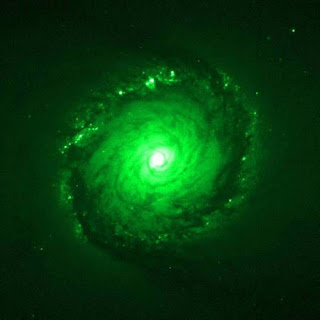
A barred spiral galaxy located some 30 million light years away toward the constellation Horologium, Galaxy NGC 1512 is bright enough to be seen with amateur telescopes. The galaxy is some 70,000 light years across, which is nearly as large as our own Milky Way galaxy. The core of the galaxy is remarkable for its "circumnuclear" starburst ring, which is an amazing circle of young star clusters that spans some 2400 light years across. Galaxy "starbursts" are episodes of vigorous formation of new stars and are found in various galaxy environments.
8: Galaxy NGC 3370
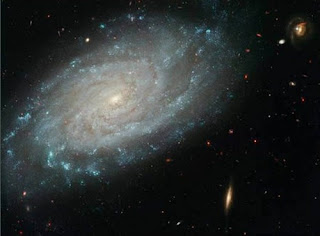
A dusty spiral galaxy located some 98 million light years away toward the constellation Leo, the center of NGC 3370 shows well delineated dust lanes and an uncommonly ill-defined nucleus. This view of NGC 3370 was obtained by the Hubble Space Telescope using the Advanced Camera for surveys and is sharp enough to identify individual Cepheid variable stars in the galaxy. Cepheid variable stars are used to establish extragalactic distances. In 1994, a Type Ia sypernova exploded in NGC 3370. (Credit: NASA, The Hubble Heritage Team and A. Riess; STScI)
9: M81
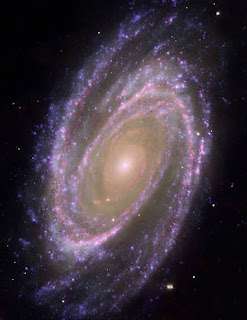
The big and beautiful spiral galaxy M81, in the northern constellation Ursa Major, is one of the brightest galaxies visible in the skies of planet Earth. This superbly detailed view reveals its bright nucleus, grand spiral arms and sweeping cosmic dust lanes with a scale comparable to the Milky Way. Hinting at a disorderly past, a remarkable dust lane runs straight through the disk, below and right of the galactic center, contrary to M81's other prominent spiral features. The errant dust lane may be the lingering result of a close encounter between M81 and its smaller companion galaxy, M82. Scrutiny of variable stars in M81 (aka NGC 3031) has yielded one of the best determined distances for an external galaxy -- 11.8 million light-years.
10: Hoag's Object
A non-typical galaxy of the type known as a ring galaxy, the appearance of Hoag's Object has interested amateur astronomers as much as its uncommon structure has fascinated professionals. Is this one galaxy or two? This question came to light in 1950 when astronomer Art Hoag chanced upon this unusual extragalactic object. On the outside is a ring dominated by bright blue stars, while near the center lies a ball of much redder stars that are likely much older. Between the two is a gap that appears almost completely dark. How Hoag's Object formed remains unknown, although similar objects have now been identified and collectively labeled as a form of ring galaxy. Genesis hypotheses include a galaxy collision billions of years ago and perturbative gravitational interactions involving an unusually shaped core. The above photo taken by the Hubble Space Telescope in July 2001 reveals unprecedented details of Hoag's Object and may yield a better understanding. Hoag's Object spans about 100,000 light years and lies about 600 million light years away toward the constellation of Serpens. Coincidentally, visible in the gap is yet another ring galaxy that likely lies far in the distance.